Showing posts with label buffalo state. Show all posts

Friday, May 13, 2016

The road from Buffalo to Hollywood

By Darrian Dowdy


The producers, screenwriters, and special effects artists of Hollywood had to start somewhere. For some people, their road began in Buffalo.

Adam Steigert, Buffalo filmmaker and CEO of Deftone Pictures Studios Inc. (deftonepicturesstudios.com), started working on films in his early teens, when he began writing scripts.

“I was always told to write what you know,” Steigert said. “That’s the best way to tell a story.”

Tyler Cheman, Buffalo filmmaker, started producing independent films in 2012. 

“I began to watch the ‘behind the scenes’ more often over the years, and admired the hard work and dedication going into each and every scene,” Cheman said.

In recent years, the Buffalo film community has been rapidly expanding.

“When I started there was no film community in Buffalo,” Steigert said. “I wish there was the supportive community that there is now in our local scene, but there wasn’t.”

“Buffalo is growing a lot in the industry,” Cheman said. “We as a community have been upgrading equipment for various groups to better our films.”

“Buffalo is a haven for beautiful landscape,” Steigert said. “As filmmakers we can use these landscapes to drive our stories, giving our films depth.

Our Buffalo film community has flourished, allowing creativity and talent to set the stage. What makes our community so unique is that people all over the world are catching on to what Buffalo has to offer and allowing these talented individuals to stick out, with local film companies finding interesting and creative ways to tell their stories on limited budgets. 

“The best thing is the determination and drive that our filmmakers provide to our community by just going outside, shooting a film, and impacting our community in a way that both support and embrace the people in it.”

Steigert and crew on set of his newest film, “S.T.A.R.” Photo by Dale Shero.

The Buffalo film community relies heavily on every member in order to continue creating pieces of art that go on to be seen around the world.

“Success is really who you know,” Cheman said. “Every project I’ve worked on, I’ve met someone new who has forwarded information, and in the end has bettered [everyone’s productions].”

In the film industry, having connections is one of the most important aspects of success. Visual effects artist Teague Chrystie said that having real connections was his breakthrough point.

“I had a large-enough group of friendly-enough people that when one job ended I could be fairly sure someone else I knew had something starting up,” Chrystie said. “Folks would be emailing me to see if I was available, and that’s the threshold you cross that allows you to stop freaking out about the constantly unknown future.”

Many filmmakers have the dream of working in Hollywood, but it takes a lot of hard work and dedication to actually get there. Chrystie believes it is possible for local filmmaking to lead to just as successful of a career as Hollywood filmmaking.

“Do the exact thing you want to do in Hollywood in your small town,” Chrystie said. “The person who stayed back home and faced what felt like a big adversity by trying to make films in their uninspired hellhole will have finished two features,... one of which ends up on the festival circuit, and they beat their own path from there.”

Visual effects artist Ryan Wieber has forged his path in Hollywood.

I started applying for jobs in visual effects at various TV and feature film visual effects companies all over the place, including where most of the work is, in Los Angeles.” said Wieber. 

One of his most recent jobs was as a digital compositor on “Star Wars: Episode VII - The Force Awakens.” Wieber was hired by Lucasarts (lucasfilm.com) for the Visual Effects department after submitting his reel of freelance work.

Most of my time on the movie was spent working on sequences where holograms had to be designed and composited, such as BB-8's map projection on the Falcon,” said Wieber.

Chrystie is currently working on a movie called “The Circle” starring Emma Watson and Tom Hanks. He works directly with the editor, visual effects supervisor, and director to stylize the film’s graphics.

“I've been designing graphics and animations for the social media stuff we see in the movie,” Chrystie said. “It's been an absolute blast so far.”

Cheman’s next film, “The Agents: C.O.D.E.” is a spy comedy. Set in December of 1999, a madman tries to take over the world by launching a post apocalyptic attack in what would have been the real Y2k.
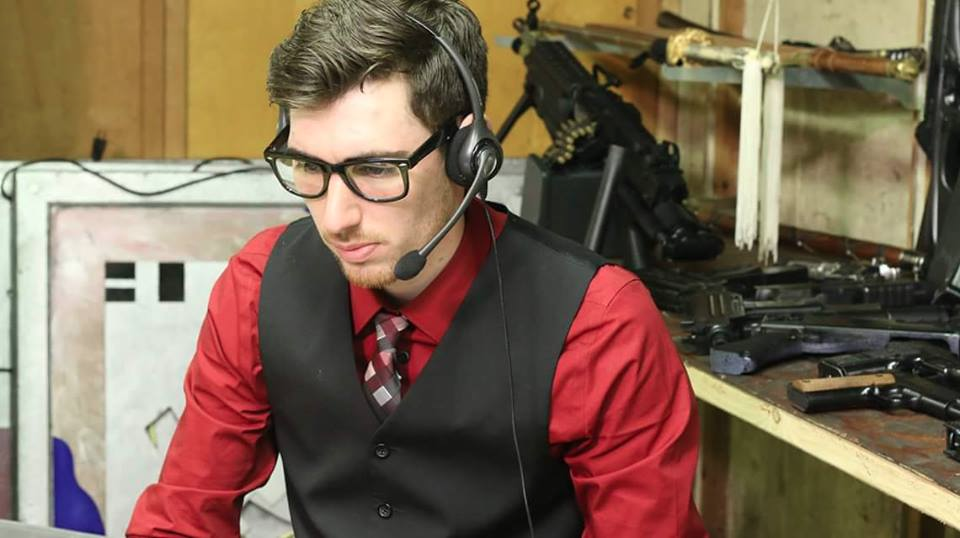
Billy Nemi on set of Cheman’s newest film, “The Agents: C.O.D.E.”
Production still courtesy of Tyler Cheman.

Steigert’s next film “S.T.A.R.” is currently in its post-production stage, being prepared for release.


Even with years of hard work and dedication, not every independent filmmaker will make their big break in Hollywood. Many will stay in their hometowns, taking jobs and doing independent films on the side.


“If you do that and it works, Hollywood will find you,” Chrystie said.


Always ask yourself, ‘What’s the end goal?’” Steigert said. “If it’s just to have a good time and make some art with some friends or fellow filmmakers, then enjoy every minute of it.

Monday, May 2, 2016

A behind the scenes look at editing

By Darrian Dowdy


Movie stars spend weeks, possibly months, perfecting their roles. But the real magic takes place behind the scenes in the editing room.

Mary Hughes, a senior at SUNY Buffalo State, has been interested media production for 10 years.

“I’ve been interested in photography since I was old enough to work a camera,” Hughes said. “My brother and I both got computers, and with the computers came these really [low-quality] digital cameras. Once I got my hands on that, I was hooked.”

Zach Cassidy, another Buffalo State senior studying media production, said that, “The first time I remember thinking I wanted to work on movies I was about ten years old… I said, ‘I want to do stuff like that. It looks fun.’”

Hughes and Cassidy want to work behind the scenes, rather than in front of the camera.

“I think production is more interesting because of all the variables that go into it,” said Hughes. “You have to deal with budgets, equipment rentals, location scouting, et cetera.

“Production is about capturing the story you’re trying to tell and then during post production you take all the pieces to the puzzle and put the story together.”


In the television control room at SUNY Buffalo State. (Photo by Mary Hughes)

Production can take more than twice as long as shooting. While shooting may take just a few weeks, post-production can take months.

“Doing something as simple as working with a one-second clip could take as long as a week to motion track. … You need to go frame by frame and adjust it accordingly,” Hughes said.

“I had to take a one-second video of someone who was flinching from a fake gunshot and add blood, a gunshot, and all these other effects. It took about a week and a half to do it all, and it was only one second long.” Cassidy said.

Post-production takes so much longer because extensive technical work goes into it. Editors handle putting together scenes from the filmed footage, adding sound and foley effects, and creating special effects with CGI.

Michael Devine, a student actor, had fun on set with special effects. In the student film “Escapism,” Devine played a villain with a disguised voice.

“I had never heard my voice through any type of audio changer,” Devine said. “There was a drastic difference.”

“The hardest part about audio work is making sure the timing is synced, otherwise it won’t look correct and the viewer will notice something is off,” Hughes said. “You take a scene and have to add every audio element imaginable.”

“It’s just so much fun creating something from nothing,” Cassidy said. “It’s just a great way to share any story you want.”


“It’s a tedious and time-consuming process but the final product always comes out really awesome,” Hughes said.

Wednesday, March 30, 2016

The art of acting

By Darrian Dowdy

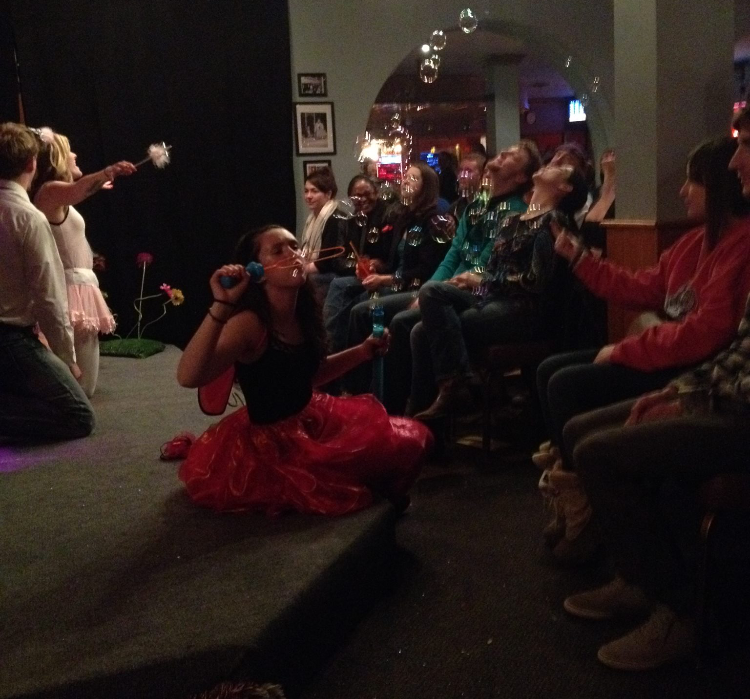
From forest fairies to Shakespearean princes, Monica Morrisey has a diverse portfolio of other personas she has embodied as an actress. Morrisey, a theater major at Niagara County Community College, has been acting since she was 12 years old.

“I’ve wanted to do something performative since I was little, and middle school musicals were what initially introduced me to acting,” Morrisey said.

Last spring, she played a fairy in the locally produced show, “420: The Musical.” This show, written in 2011 by Buffalo comedian John Kehoe, has been performed annually on April 20 in the Elmwood Village.

IMG_3312.PNG
Morrisey, center, plays a fairy in “420: The Musical” in Buffalo, April 20, 2015. Photo by Darrian Dowdy.

It features Jerry the stoner, who falls asleep and wakes up in the Land of 420. It follows his story as he tries to find the meaning of happiness.

“It was a lot of fun,” Morrisey said. “That’s where I first started to break through my comfort zone as an actor.”

She is skipping the Land of 420 this year, and moving on to the City of Verona. Morrisey will play Mercutio in NCCC’s spring performance of “Romeo and Juliet.”

“In this production, we’ve placed a lot of attention on [gender in Verona],” she said. “Verona is in present day, it’s urban and dangerous…. Romeo, Mercutio, Benvolio, the princess, and the apothecary are all played by women…. We’re portraying the characters as women.

“To play Mercutio as a woman took a little more work compared to other roles I’ve had. Shakespeare gives Mercutio this heavy monologue in which he talks about women in disdain. As a woman, is that resentment or resonance?”

Michael Devine, a theater major at Buffalo State, also has some Shakespearean experience.

“I have read Hamlet, Macbeth, Romeo and Juliet, and a Midsummer Night’s Dream,” Devine said. “It has made me think of stage acting as a small piece of the idea of acting…. It is behaving believably under imaginary circumstances.”

He has taken the skills learned from live theater and applied them to acting in film. He is not currently working on any projects, but plans to over the summer. 

“Theater has given me perspective and something to rely on when preparing for a film,” Devine said. “Theater will teach you what acting is and will better prepare you.”

“I think it’s important to have an introduction to theater when doing a film,” Morrisey said,  “but there are a lot of fundamentals that you have to throw out the window when you do a film.”

Morrisey and Devine agree that film is an individual entity.

“Film is more precise,” Devine said. “It’s specific action, whereas stage is a bit more free and has more range.”

“Hurry up and wait,” Morrisey said, “You hurry up, get into costume, get all your props, be ready, and wait for when you’re called.”

Morrisey says that she prefers theater over film. “Will I [continue to] audition for films and take parts? Absolutely, but it’s not my end all…. Buffalo runs on this schedule where everyone has a day job, and they act, rehearse, audition at night.” Morrisey hopes to follow that path.

Wednesday, March 9, 2016

From Los Angeles to Buffalo: A night at the Oscars

By Darrian Dowdy


Michael Devine spent Oscar night in a suit and tie, walking the red carpet, and posing for photos. He even took home the award for Best Actor.

Devine, a theater major at SUNY Buffalo State, wasn’t in Hollywood. He was on campus at the 9th Annual Television and Film Arts Night at the Oscars, a multimedia gala celebrating the Academy Awards as well as Buffalo State student films.

“It was very classy, right from the start,” said Devine, who starred in three student films nominated for awards. “Everybody was dressed up, it was very formal. ... A fantastic atmosphere.”

Community members were invited to walk on a red carpet and view the Oscars projected on the big screen in the Student Union Social Hall, all while enjoying live music and complimentary refreshments. 

Oscars Poster - TFA Program

The Sunday evening event also encouraged audience members to vote for the best student films of the year. The films were available for prior viewing online, or at iMac terminals set up around the hall. The awards of the night were Best Director, Best Screenplay, Best Picture, Best Actor, and Best Actress.

Devine assumed he won his Best Actor award for the short film, “Affinity.” 

“I don’t know for sure,” he said. “There was just a name attached to the category, there was no film attached to the name.”

TFA major Eliza Zanolli-Stiles was the director of “Affinity.” The three-minute short film is about a man whose world goes black and white after a recent breakup, until he meets a new woman.

“His world gradually begins to turn back to color,” Zanolli-Stiles said. “Affinity” won her the award for Best Director. “This was a film that I was very proud of and put a lot of work into, and I was glad to be recognized for that.” She also took home Best Actress for her work in three films.

Other films recognized at the event were “I Like You A Latte” for Best Screenplay, and “The Devil’s Dime” for Best Picture.

Jordan Sims, writer, director, producer, and editor of the short film “Solid Foundation” said, “It’s a chance to showcase our own work. … It’s our own little taste of what the future may hold.”

“It’s not even about winning awards,” said Zanolli-Stiles. “It’s just to showcase [the] work work that [we’ve] spent so much time and energy on.”

The audience turnout this year was lower than past years, Sims said. 

“I think that’s more to do with the Oscar’s themselves…,” he said “It’s not appealing to the mass audience anymore. The Oscars are getting too far into their own little bubble, and they forget that we’re all normal people. TFA can get better and better every year with this Night at the Oscars, but if the Oscars themselves aren’t really that interesting, it’ll kind of all be in vain.”
 
“I hope to see it grow,” Zanolli-Stiles said. “I think we have a pretty good thing going right now and hopefully it will continue to evolve as the years go on. … It’s such a unique experience.”

“It was very nice and very humbling to see that my work is noticed,” said Devine. “It changed me as a student film actor.”